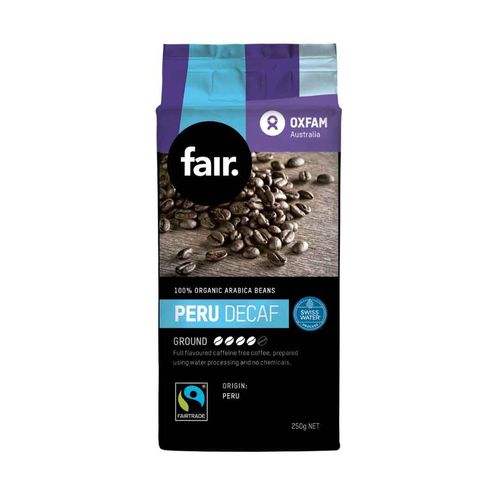
Oxfam fair Peru Decaf Fairtrade Organic Ground 250g
Localização: Victoria, Australia
Experience the best of decaf with our 100% Fairtrade Organic Arabica beans. Swiss Water processing ensures a chemical-free, full-flavoured coffee with rich taste, sweetness, and perfect body balance. Suitable for filter, stovetop, and plunger brewing. Taste Profile: Retaining rich flavours, residual sweetness and excellent balance of body. Brew method: Filter, stovetop, plunger Ingredients: 100% Fairtrade Coffee Coffee Bean Origin: FLO ID 6594
Jornada
- Producer Organisation
Founded on October 16, 2011, Cooperativa Agroecológica Industrial Juan Santos Atahualpa (CAIJSA) began with a small group of 20 producers. Today, it has over 586 producers spread across Pichanaki, Perené, Río Negro, Pangoa, Río Tambo and Puerto Bermúdez in Peru. The CAIJSA vision "be a sustainable and decentralized organization, leader in the production and export of specialty coffees," as well as "positioning new markets, with self-sustainable bases, respectful of the environment and cultural customs." Activities that they conduct to benefit their partners include technical assistance for coffee growth, training in topics such as "composting, conservation of ecosystems and soils, organic standards, harvest and postharvest handling, organic and inorganic waste management, integrated pest management, dangerous use of pesticides, wildlife, [and] energy use." They also hold training focused on gender equality, non-discrimination, job security, and the prohibition of child labour.
- Producer Organisation
Central De Cafetaleros Del Nor Oriente (CECANOR) , located in Chiclayo, Peru, is an agricultural organization of 800 producers that prides itself on promoting female coffee growers through its Café Femenino products. The women of CECANOR are proud to be the originators of the Café Femenino concept, and began this program when 464 female coffee producers in Peru united to take a step toward empowerment by creating the first Café Femenino co-op in 2004. This program has now grown to include cooperatives all around the world. Along with being Fairtrade Certified, CECANOR is also certified as a bird-friendly coffee producer by the Smithsonian National Zoo and Conservation Biology Institute and has been since 2012. CECANOR has provided a litany of benefits to nearby communities. After more than 13 years, domestic abuse and malnutrition rates have gone down, education and income equality rates have gone up, and the women are no longer too timid to speak. They now stand up in front of groups, make presentations, and hold several elected positions on the boards of the coffee associations of Cecanor. Their hard work and courage mean the women in their community have more decision-making power, income, and dignity, than ever before." Pounds of Bird Friendly Coffee Produced: 548,875 (Smithsonian National Zoo and Conservation Biology Institute)
- Harvesting
The harvesting of coffee berries is a delicate and crucial phase in the coffee production process, where the careful picking and selection of ripe, high-quality cherries set the stage for the ultimate flavour and quality of the final product. Selective Picking: In the best coffee farms, harvesting is often done by hand through a process known as selective picking. Skilled pickers move through the coffee trees, meticulously selecting only the ripest cherries. This attention to detail ensures that each cherry has reached its peak maturity, which is essential for developing the rich and complex flavours that coffee lovers cherish. Selective picking is labor-intensive and time-consuming but it is vital for producing premium quality coffee. Strip Picking: For larger coffee plantations, a method called strip picking might be used, where all cherries are stripped from the branch at once. This method is faster and less labour-intensive, but it often requires further sorting to separate ripe cherries from unripe ones. While not as precise as selective picking, advancements in sorting technology help maintain quality even with this more efficient method. Post-Harvest Selection: Once harvested, the cherries undergo another round of careful selection. Any remaining unripe or overripe cherries are removed, ensuring that only the best cherries proceed to the processing stage. This step is essential to avoid any off-flavours that can arise from imperfect cherries. The meticulous process of harvesting coffee berries is not just about gathering fruit; it’s about preserving the potential of each cherry to create an exceptional cup of coffee. The dedication and precision involved in this step reflect the passion and commitment of coffee producers to deliver the highest quality product to consumers. Each carefully picked cherry contributes to the intricate tapestry of flavours that define great coffee, ensuring a delightful experience with every sip.
- Processing
Coffee bean processing is a pivotal stage in the journey from harvest to cup, where meticulous procedures transform freshly picked coffee cherries into raw beans ready for roasting. This crucial process involves several key steps, each essential in shaping the flavour and quality of the final coffee product. Depulping: Once sorted, the outer pulp of the coffee cherry is removed in a process known as depulping. This step is crucial in exposing the beans, which are nestled inside the fruit. The method of de-pulping can vary, ranging from mechanical devices to traditional methods like fermentation. Fermentation: Some processing methods involve fermentation, where the de-pulped beans are soaked in water to remove any remaining fruit residue. This natural process also initiates chemical reactions within the beans that contribute to their flavour profile. Swiss Water Process Decaffeination: For decaffeinated coffee, the beans undergo the Swiss Water Process, a chemical-free method that uses water and charcoal filters to remove caffeine while retaining the beans’ natural flavours. This gentle process ensures a flavourful decaf coffee without compromising taste. Throughout each stage of processing, utmost care is taken to handle the beans delicately and avoid any damage that could impact their flavour. Coffee bean processing is not merely a technical procedure; it is an art form that requires precision and expertise to unlock the full potential of each coffee cherry. From the farm to your cup, every step in the process contributes to delivering a delightful coffee experience that captivates the senses and satisfies coffee enthusiasts worldwide.
- Drying
Harvested coffee beans embark on an essential journey through the drying process to reduce their moisture content. This critical step can be achieved through various methods, each adding its unique touch to the beans' final character. Sun Drying: In this traditional and natural method, coffee beans are spread out on large patios or raised drying beds under the warm embrace of the sun. They are carefully turned by hand to ensure even drying. This method is not just about reducing moisture; it’s a ritual that allows beans to slowly absorb the nuanced flavours of their environment, often resulting in a sweeter and fruitier cup. Mechanical Drying: Embracing modernity, mechanical drying involves the use of specially designed machines to rapidly reduce moisture content. This method offers greater control over the drying process, making it possible to achieve consistent results regardless of weather conditions. It’s a faster method that ensures efficiency and reliability, often producing a cleaner and more uniform flavour profile. Hybrid Drying: Many coffee producers opt for a combination of sun and mechanical drying. By starting the process with the sun and finishing with mechanical dryers, they can harness the best of both worlds—capturing the complex flavours imparted by natural drying while ensuring the beans reach optimal moisture levels quickly and consistently. The drying process is more than a mere technicality; it’s a crucial stage that guards against mould and deterioration. By carefully managing this phase, producers can profoundly influence the final taste and quality of the coffee. Whether aiming for a bright, vibrant flavour or a deep, rich profile, the drying method plays a pivotal role in shaping the beans' destiny. Thus, each cup of coffee carries within it the story of its drying process, a testament to the care and expertise of the producers who bring out the best in every bean.
- Grading
The grading of dry green coffee beans is a pivotal step in the coffee production journey, where the quality and potential of each bean are meticulously evaluated. This process serves as a critical checkpoint, ensuring that only the finest beans make it through to the subsequent stages, ultimately guaranteeing a superior coffee experience for you, the consumer. During the grading process, beans undergo a rigorous assessment based on several key criteria: Size: Beans are sorted by size to ensure uniformity. Larger beans often indicate a healthier growth process and are typically associated with more robust flavours. Uniform size also ensures even roasting, which is essential for achieving a consistent taste profile. Colour: The colour of the beans is scrutinized to determine their maturity and quality. Ideal beans exhibit a vibrant green hue, indicating they were harvested at the peak of ripeness. Any discolouration might suggest issues such as over-fermentation or improper drying, which can negatively impact the flavour. Density: The density of the beans is another crucial factor. Denser beans are generally considered higher quality as they have more substance and often produce a richer and more complex cup of coffee. Density is usually checked by how the beans sink or float in water. Defects: Perhaps the most critical part of the grading process is identifying and removing defective beans. Defects can range from insect damage and mould to broken or misshapen beans. Even minor defects can affect the taste and aroma, so precision in this step is essential. After this thorough evaluation, only the best-grade beans advance to the roasting and packaging stages. This meticulous selection process ensures that every batch of coffee meets high standards of quality, delivering a rich, nuanced flavour and an enticing aroma. Ultimately, the grading process is more than just a quality control measure; it’s an art form that reflects the dedication and expertise of coffee producers. By carefully selecting the best beans, they lay the foundation for a delightful coffee experience, transforming the humble green bean into a cup of excellence.
- Roasting
Fair. Coffee is proudly roasted by Bean Alliance Group. Since our establishment in 1981, our Melbourne-based roastery has been dedicated to crafting coffee that consistently delights every palate and brewing preference. At the heart of Bean Alliance Group lies a commitment to quality. Our state-of-the-art facilities empower us to meticulously roast and blend coffee beans to perfection. We take pride in being the first roaster in Australia to achieve Australian Certified Organic coffee status. Later, we expanded our commitment to include Fairtrade certification, ensuring our coffee not only tastes exceptional but also supports fair and sustainable practices. Sustainability is more than a buzzword for us—it’s a core value embedded in everything we do. From sourcing beans to packaging, we prioritise eco-friendly practices that minimize our environmental footprint. By choosing Fair. Coffee, you’re not just enjoying a cup of coffee; you’re supporting a commitment to sustainability and ethical sourcing. Our dedication to quality, sustainability, and fairness extends across our diverse portfolio of brands. Whether you prefer a bold espresso or a smooth latte, Fair. Coffee offers a range of blends and single origins to suit every taste preference. At fair. Coffee, our journey is fueled by passion and a relentless pursuit of excellence. Join us in savoring the perfect cup of coffee, crafted with care from our family to yours.
- Brewing
Carefully sourced Fairtrade beans journey from farm to grinder, where their aromatic potential is unlocked. As hot water saturates the freshly ground coffee, each drip weaves a story of farmers supported, communities uplifted, and ecosystems cherished. In the warmth of a Fairtrade mug, every sip becomes a celebration of ethical choices. This nurturing ritual not only invigorates the body but also soothes the soul, making each cup a toast to a better world, one sip at a time.
Impactos
- Fairtrade Premium - CECANOR
- Meet Natividad