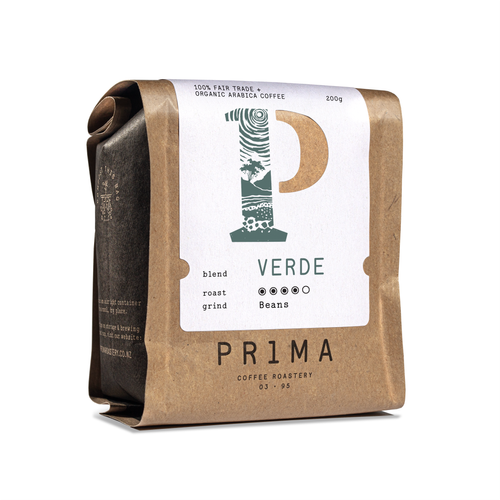
Verde Blend
Locatie: Christchurch, New Zealand
Developed with the requirements of a new café in mind, our Verde takes simple, bold flavours as its starting point and delivers an espresso with clean sweetness, solid body and a satisfying, lingering finish. Notes of ripe stonefruit, molasses and almond make this a fine addition to the Prima Fairtrade Organic selection.
Reis
- Producer Organisation
Established in 2013, Asociación de Productores Ecológicos de Planadas (ASOPEP) is located in the Southern Andes Mountains, in the region of Tolima in Colombia. Formed "in response to the felt need to organize a way of relating between the 167 members of an association with several objectives: commercialize their own coffee production, form their own form of government and design their own farm conservation model to guarantee resources to future generations", ASOPEP uses its support from Fairtrade to provide for children in the community, through a variety of initiatives including learning about coffee production, preparation of coffee-based drinks, recreational sports like soccer and swimming, and music lessons. According to State Fair Trade Coordinator (Coordinadora Estatal de Comercio Justo), "Each partner and producing partner grows on average about 6 acres of coffee grows, and its economy is based solely on income from coffee production." To support their community, they support initiatives such as "The School for Building the Future", trainings for adapting to climate change and utilizing sustainable farming techniques, and "The Women's Committee: AVA - Art Life Soul."
- Producer Organisation
The Reyna del Café de San Juan RL Agricultural Cooperative is a non-profit association and is located in the municipality of San Juan del Rio Coco, department of Madriz in Nicaragua, with coverage of 22 communities. With 224 producers, The Reyna del Café de San Juan RL Agricultural Cooperative provides direct technical assistance to producers through hired technicians, which, according to their website, details "recommending and teaching cultural, biological and organic practices that lead to compliance with the different criteria and standards of the certification agencies." Trainings are also held to help producers learn about sustainable, organic farming that reduces damage to the environment, conserves soil, and they help to "stabilize annual production volume and allow the associate to increase [their] income." Administrative savings, along with funds like the Fairtrade Premium, helps the cooperative to provide funding for producers to export their coffee. Some of their featured projects include a 2018-2019 construction project focused on improving the conditions of coffee processing for producers, as well as a campaign to construct new water collection batteries. Other projects that they have completed using the Fairtrade premium involve financing of other producer needs such as pulp trees and filters, as well as funding scholarships for children in the community.
- Producer Organisation
Cooperativa de Servicios Agropecuarios Gualcinse, Ltda (COSAGUAL) is a farming cooperative with almost 10,000 members that has a mission to "promote development processes in families dedicated to agricultural production, with gender equity and in harmony with the environment, providing services with responsibility, efficiency, and commitment to our cooperative, community, and country, oriented in our ethical and moral values.” Through the support of Fairtrade and their use of the Fairtrade Premium, COSAGUAL has been able to provide partners and nearby communities with agricultural supplies and equipment, health insurance from the sole hospital in the region, scholarships for students to attend professional and university education, environmentally friendly and organic fertilizers, and employment opportunities. COSAGUAL provides a variety of coffee types to its customers, including "Typica, Catuaí, IHCAFE 90, and Lempira; each of the production units [is] registered and managed under the technical specifications established by COSAGUAL, which allows [us] to offer year after year a coffee of the same quality, a fact that is appreciated by our buyers.”
- Producer Organisation
Highland Organic Agriculture Cooperative (HOAC) is one of the oldest Fairtrade Certified organisations in Oceania. The Cooperative is located in the remote regions of the Eastern Highlands Province of Papua New Guinea. Located in remote mountainous locations, it often met limited communication between member, coupled with high transport costs which were compounded with lower prices to producers and more difficulties in access to markets. Registered in 2003, HOAC is a cooperative of 2,600 coffee growers, some of whom are certified organic by NASAA. It is estimated that between 50,000 to 60,000 people receive benefits from the Cooperative. Coffee Connections is HOAC’s exporter. In this region, coffee farming is the main way of life for most families. Using their Fairtrade Premium, HOAC has improved infrastructure such as roads, funded a clean water initiative for local communities, invested in health initiatives such as new beds for local hospitals, maintained and purchased vehicles and machinery, and invested in education for local children.
- Harvesting
Harvesting of coffee berries, where careful picking and selection of ripe, quality cherries is crucial to ensure optimal flavor and product quality.
- Processing
Coffee bean processing is a crucial step in product development where harvested coffee cherries undergo a series of procedures to extract the raw coffee beans. These procedures typically include sorting, depulping, fermentation, drying, and storing. The chosen method of processing can greatly affect the flavor of the coffee. During this stage, utmost care is required to prevent damage or deterioration of the beans. After processing, the beans are packed and transported to roasting facilities.
- Drying
Harvested coffee beans undergo a drying process to reduce their moisture content. This can be carried out using different methods including sun drying, mechanical drying, or a combination of both. This step is crucial to prevent mold and deterioration, and it influences the final taste and quality of the coffee.
- Grading
The grading of dry green coffee beans is a crucial step in the product development process where the quality of the beans is determined. Here, the beans are assessed based on size, color, density, and possible defects. Only the best grade beans proceed to the next steps, ensuring the final coffee product offers a superior taste and aroma.
- Roasting
Coffee bean roasting is the process where green coffee beans are transformed into roasted coffee products. It's a crucial step in product development as the beans undergo a heating procedure to achieve desired flavors and aromas. The temperature, timing, and roasting method can significantly impact the taste profile of the final product, making this step a blend of science and art. The beans are typically roasted until they reach a specific internal temperature, usually between 370°F and 540°F. They may be lightly, medium, or dark roasted, each providing a different taste intensity.
- Brewing
Selecting quality coffee beans, grinding them to the correct consistency, and using a brewing method to extract flavor. The result is a freshly made coffee. Factors like water temperature, brew time, and coffee-to-water ratio are carefully monitored to ensure the perfect cup. Cafes all over brew wonderful delicious coffee for their customers.
Effecten
- Fairtrade Certification
- Fairtrade Premium