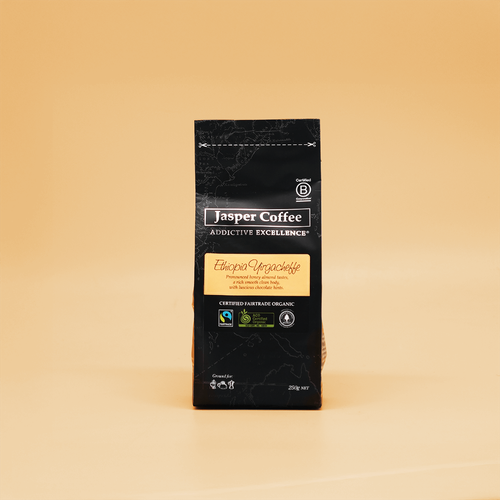
Ethiopia Yirgacheffe
Sijainti: Victoria, Australia
Region: Kochore Altitude: 1400-2400m Harvest: September – December Varietal: Typica and Heirloom Guji Process: Fully Washed Treat yourself to this Ethiopian delight, with sweet notes of Peach and Nectarine, with a smooth chocolate finish Origin Story: Our Yirgacheffe is an elegant well structured, all consuming coffee experience. It starts with immediate sweet stone fruit, nectarine or apricot, then gains austerity in the mid palate with toasted almonds and soft milk chocolate to smooth the way for sip after sip. As a long black…memorable, and the amazing flavours just last longer. Brewed as a filter this coffee is sweet and delicate and enhances the very high altitude character with clean finesse and assurance you are drinking an ancient bean.
Matka
- Producer Organisation
Established in 2002 and Fairtrade Certified in 2009, Yirgacheffe Coffee Farmers’ Cooperative Union Ltd. (YCFCU) represents over 46,094 farmers with 28 member cooperatives, located in Gedeo Zone in Southern Ethiopia. This is the only region in Ethiopia that produces Yirgacheffe coffee. They have dedicated 62,004 hectares to coffee production. Their farmers are united across (Dilla, Wonago, Bulle, Yirgacheffe, Kochore, and Gedeb). According to their website, they have also increased the price paid to producers due to new competition between cooperatives and private traders that benefits poorer farmers, and have provided loans to producers in need. Their website also states that "All Fairtrade certified cooperatives are conducting social development projects which comes with funds support under the fair trade premium fund. The achieved projects under this includes among others; bridge construction, additional school class construction and improvements to the electricity transmission infrastructure. This indicates that cooperatives contribute to local development due to their fair trade certified products. Therefore, the export volume of fair trade coffee has also increased and has helped buffer fair-trade coffee farmers from international price fluctuations." Average Annual Production: 20,000 metric tonnes
- Harvesting
Harvesting of coffee berries, where careful picking and selection of ripe, quality cherries is crucial to ensure optimal flavor and product quality.
- Processing
Coffee bean processing is a crucial step in product development where harvested coffee cherries undergo a series of procedures to extract the raw coffee beans. These procedures typically include sorting, depulping, fermentation, drying, and storing. The chosen method of processing can greatly affect the flavor of the coffee. During this stage, utmost care is required to prevent damage or deterioration of the beans. After processing, the beans are packed and transported to roasting facilities.
- Drying
Harvested coffee beans undergo a drying process to reduce their moisture content. This can be carried out using different methods including sun drying, mechanical drying, or a combination of both. This step is crucial to prevent mold and deterioration, and it influences the final taste and quality of the coffee.
- Grading
The grading of dry green coffee beans is a crucial step in the product development process where the quality of the beans is determined. Here, the beans are assessed based on size, color, density, and possible defects. Only the best grade beans proceed to the next steps, ensuring the final coffee product offers a superior taste and aroma.
- Roasting
Coffee bean roasting is the process where green coffee beans are transformed into roasted coffee products. It's a crucial step in product development as the beans undergo a heating procedure to achieve desired flavors and aromas. The temperature, timing, and roasting method can significantly impact the taste profile of the final product, making this step a blend of science and art. The beans are typically roasted until they reach a specific internal temperature, usually between 370°F and 540°F. They may be lightly, medium, or dark roasted, each providing a different taste intensity.
- Brewing
Selecting quality coffee beans, grinding them to the correct consistency, and using a brewing method to extract flavor. The result is a freshly made coffee. Factors like water temperature, brew time, and coffee-to-water ratio are carefully monitored to ensure the perfect cup. Cafes all over brew wonderful delicious coffee for their customers.
Vaikutukset
- B Corp Certified
- Fairtrade Certification
- Fairtrade Premium
- Fairtrade Premium - HOAC